
What ChatGPT can actually do for your English learning.
Let’s start with the good news: Used well, ChatGPT can support your English learning journey in more ways than people realize.
Now, I know you might have heard that AI kills creativity, or makes you lazy. Honestly, used badly, I’d agree. But, that’s exactly why I’m here: to show you how I’ve seen it genuinely help my students make real progress independently.
Reading & vocabulary
As an English teacher, I always tell my students to read outside the classroom. Spoiler: they never do.
But the few that actually listen usually come back with the same complaint “Omar I’ve tried, but every book Is written for native speakers at a much higher level”
Sound familiar?
So is the solution to read kids books? Clearly not.
This is where ChatGPT genuinely proves its worth. It’s great at generating reading material that’s actually at your level – not too easy, not too hard.
Ask it for a short story or article on any topic that you like, adjusted to your level and bam. Just like that, you’ve got reading material built around exactly what you’re looking for.
Cool, right?
Well let me tell you that it can also:
- Create comprehension questions for what you have just read.
- Explain a word you’re stuck on, even tricky metaphors.
- Give you common word pairings (“collocation”) so you can start to sound like a native speaker.
- build vocabulary matching or fill-in-the blank activities, and check your answers.
Sometimes my students are surprised when I tell them I don’t know every single word in the dictionary. How shocking of me, right?
So what do we do when this happens? Send a quick message to our good old friend ChatGPT. It´ll break the word down, give you definitions, examples and anything you could possibly need.
A five second exchange often does more than ten minutes of endless dictionary searching.
Writing
Struggling to write an email, or not sure if your message sounds too formal or casual? If this is true for you, you’re not alone. It’s one of the most common problems that English learners bring to me.
Good news: This is one of the best ways to use the AI tool to improve your English.
And no I’m not saying that you just tell the program to write it all for you. (Before you get me into trouble with your teacher - we can always tell.) I’m talking about making your writing better. Here are some tricks, I use myself, even as an experienced writer:
- Adjust tone between formal and casual so you can compare which one fits your specific situation.
- Get a writing prompt for inspiration, to help you past the first line.
- Finish a partially-written paragraph, rather than writing it all for you.
- Plan and brainstorm ideas by walking through the writing process step by step.
- Get detailed feedback and advice on how to improve.
Trust me, even writing this article, I rewrote the same line about five million times. I know exactly what it feels like to want to headbutt the keyboard.
But just by using these simple tricks, the writing process gets a lot easier and your skills improve with it.
Pronunciation
Ah the dreaded pronunication of English. The language where “Worcestershire” is somehow pronounced “Wuss - ter”, where “tomb” is pronounced “toom”, and where “bomb” is pronounced ... yep you guessed it, “bom” (face palm.)
As many of you quickly realise, English pronunciation is a master of confusion and getting it right actually does matter. Mixing up a single sound can completely change your meaning, and not always in a way you’d want your listener to notice.
One of my students spent weeks mixing up “sheet” and ... well, you can guess the other word. A few rounds of repeat and correct with ChatGPT, and she never made that mistake again.
So how do you learn the pronunciation of a language that won't even follow its own rules?
To really get the best out of it to improve our pronunciation, you'll want to use its voice mode as this is where it genuinely shines.
Ask it to say a word out loud, repeat it back yourself, and then ask it to tell you exactly what you got right or wrong. It’s like having a patient pronunciation coach on call who really won’t get tired of you saying “squirrel” 15 times in a row.
A few ways to get more out of this:
- Ask it to use the word in a sentence, so you can hear how pronunciation changes in natural, connected speech, not just the word on its own.
- Ask for a list of words that rhyme or sound similar or sound similar, think “ship” and “sheep”. This is one of the best ways to train your ears.
- Ask it to describe what your mouth, tongue and lips should be doing for a specific sound. This is really useful for sounds that don’t exist in your first language.
Small habit. Big difference
Speaking & conversation practice
This might be the single most underrated use of AI, especially if you don’t know many english speakers or just simply don’t have anyone to practice with. Just turn on the mic, hit voice mode, and ChatGPT can simulate entire situations such as ordering food at a restaurant, a job interview even a doctor's visit. No booking required.
A couple things to bear in mind:
- It won’t correct your mistakes automatically (you need to ask)
- You can choose how it corrects you (with subtle hints or complete corrections)
- You can direct the conversation toward academic English or casual slang, depending on what you need
This kind of practice genuinely helps. I’m sure many of you have lived through the classic mix up, confusing the English word “embarrassed” with the Spanish “embarazada” which actually means pregnant. P.S share your own in the comments so I can laugh a little.
Don’t worry. We’ve all been there.
But here’s the thing: It’s okay to make mistakes. In fact, it's good as it shows you’re trying. If you’re still a little nervous, or don’t feel confident speaking to native speakers yet, ChatGPT is there and I promise you, it won’t judge you.
Pragmatics (aka not sounding rude by accident)
This is the stuff that most textbooks and sometimes even teachers skip entirely. But what exactly is pragmatics I hear you ask?
Let me explain with an observation that always surprises my friends back in England. Whenever we visited Spain, they’d be confused by how people ordered a coffee. “Ponme un café” (give me a coffee) sounds very rude at first especially next to the English equivalent which is closer to “please, if you don’t mind would you be so kind to bring me a coffee”.
Okay, slight exaggeration, but you get the point.
That’s pragmatics in action and it matters more than you think. get it wrong, and people might think you’re rude without you ever meaning tone.
Turns out, ChatGPT is genuinely good at helping here. Here’s how:
- Roleplay real situations: Meeting your girlfriend’s dad (scary), a job interview, small talk with coworkers. Tell it the exact scenario, and notice how differently it talks to you in each one.
- Ask it to correct you or get angry: Literally say: “Tell me if I sound rude, agressive, or too direct.” You’ll be surprised by how often a completely normal sentence in your language sounds a bit rude in English
- Practice formal vs casual: Ask for the exact same conversation twice – once with your boss and one with your friend and then compare
- Test your jokes before you test them on a human: Humor has a bad habit of not translating well across languages. Just ask ChatGPT : “would this be offensive in English?”. Better than finding out the hard way. right?
Small talk, interviews, first dates – pragmatics is quietly running in the background of it all.
Get it right, and you will will start sounding less like someone learning English, and more like someone who just speaks it.
Where ChatGPT falls short (the slop)
Before you start thinking about replacing ChatGPT as your personal tutor, i’m afraid it’s not all smooth sailing.
So what should you actually watch out for?
- It hallucinates confidently: ChatGPT has a bad habit of being flat-out wrong, while sounding completely sure of itself like google maps that’s dead certain the lake is just a shortcut.
- It misses mistakes: Even when you ask it to correct you, it won’t always catch obvious errors.
- It struggles with multi-tasking instructions: Ask it to hold a natural conversation and correct you and stay in character all at once and it’s got the focus of a parent trying ti finish an email while a toddler asks for a snack for the fifth time - something’s getting dropped.
- It doesn’t truly “understand” language the way you do: It’s built on patterns, not genuine reasoning, so it can’t always tell the difference between what’s grammatically possible and what isn’t, the way a native speaker can.
- It’s not a replacement for real interaction: No body language, no emotion, none of the unpredictability of a real human interaction.
So how do you get more of the good and less of the slop?
It mostly comes down to how you ask.
ChatGPT prompts for English learners
Here are a few ready-to-use ChatGPT prompts for English learners, organised by skill:
Speaking
“Roleplay as a hotel receptionist. I’m checking in. Stay in character and correct only major mistakes at the end.”
“Let’s have a conversation about [topic]. Try to correct my major mistakes, but keep the conversation flowing naturally.”
Writing
“Write this email two way - formal and informal. Then ask me to guess which specifc words or phrases you changed to shift the tone, before you tell me.”
“Here’s a paragraph I wrote for my [ type of exam]. Don’t rewrite it, just tell me what’s working and what to imrpove. I’ll revise it myself, then send you a new version to check.”
Vocabulary
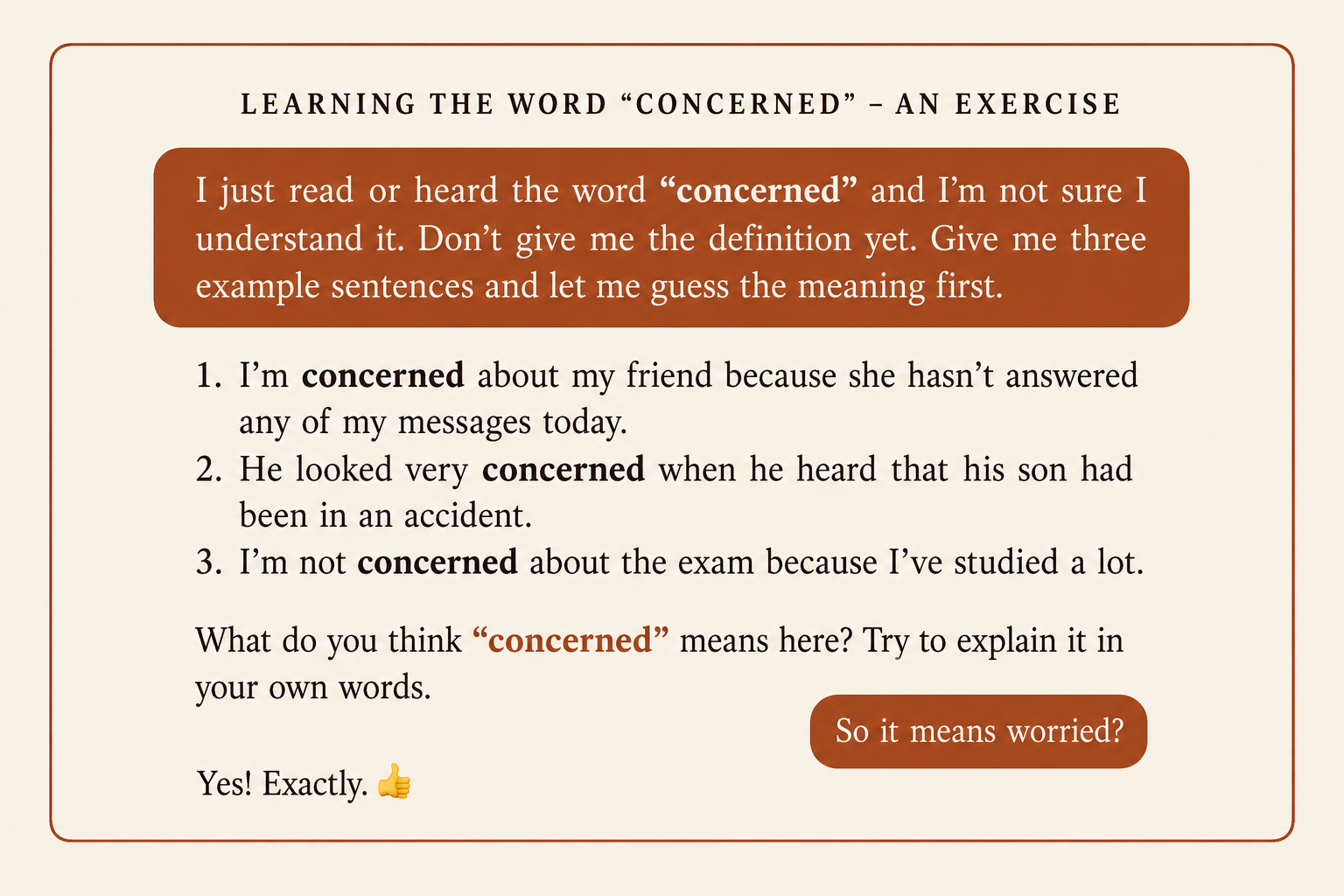
“Give me 5 collocations with the word [word], but don’t give me the definition yet. Give me three example sentences and let me guess the meaning first”
Pronunciation
“Say the word [word] out loud, then let me try to repeat it back to you. Tell me exactly what I got wrong.”
“Now use [word] in a full sentence and say it out loud- I’ll repeat it back to you. Tell me if the word changes at all once it’s part of the longer sentence.”
Pragmatics
“I’m going to [event]. How do I introduce myself in a way that’s polite but not too formal?”
“Here is a sentence I want to say to my [person]. Does it sound rude or natural in English? If it’s rude, give me a better way to say it.”
Join the conversation
Got a question or something to add? Leave a comment below — comments appear once they've been reviewed.
0 comments
Loading comments…